
Something that one player and I always do is make his characters for my campaigns together. It's something that works really well, for both of us, and I think it's a practice that really helps flesh out a character and plant some solid story hooks.
He usually comes up with an idea or concept on his own, thinks about it a bit, and then comes over and we hammer out the details. As a DM, I can offer suggestions that he may not have thought of, or outright tell him if a power/feat choice is a bad idea (like focusing on an undead-hunting theme in an undead-light campaign).
One of the first things we discuss is if his character works in the campaign. For instance, he had an idea for our upcoming Dark Sun campaign to be a Raven-based warlock. Problem was, not only is this an arcane class (meaning that since it's Dark Sun, there should probably be a bit more history/backstory established as to how he is able to use arcane magic) but he also wanted to use a Spellscar, something from Forgotten Realms with FURTHER arcane magic connections.
If he had showed up on game night with this character, I would have been put in a tough situation. Without some time to think about it (such as even looking up what a Spellscar IS) I probably would have said his PC wasn't eligible for Dark Sun play since I had no idea how his powers worked and if they were even possible in Athas. He would have had to make a new one, and delayed the game...something which would have satisfied no one. Instead, however, we were able to look up Spellscars and toss some ideas back and forth how exactly it worked in the Dark Sun universe. (Long story short, it was because a Sorcerer-King cursed him years ago.)
Another way this shared character-building is helpful is when it comes to planning his backstory! Initially when I asked him what his character did, he had some vague idea of being an old (really old) wandering nomad, with magic powers because of "a curse". And he had a giant (medium-sized) pet Raven that also served as a mount.
This was alright, but other than the raven, it's pretty bland and lacking in specificity and hooks. And the raven...WTF. How the hell would this fit into the story? But don't get me wrong - this is a great time for a DM, as you can take what your player has in mind and not only enhance it, but also enhance it in a way that it will flawlessly fit into your campaign. And by doing it together, cooperatively, it's still HIS backstory...you just helped steer him to the final version.
I proposed some different ideas, and after discussing them a bit, throwing some out, modifying some others, his character became a nomad who wandered between city-states as a special courier, riding his Raven mount (keeping his close connection to the Raven.) We also decided that the reason his arcane abilities have not gotten him locked up, enslaved or killed by a Sorcerer-King (SK) is because he is actually doing the SK's bidding, by serving as a guardian to the SK's favorite, exotic, last-of-its-kind pet...a Dire Raven. The Raven was suffering/dying in captivity, unable to be free and run/fly unhindered, so the SK had to free it. And to ensure that it would be protected, he charged the player's character with the responsibility of guarding it, and "blessed" him with powerful magic abilities.
Thus is this character able to use arcane magic & not be killed by the SK, and it the Dire Raven's need to be free and restless nature also connects nicely to why they are always on the move, living a nomadic life.
From there, we moved on to the sometimes tricky question of why the character is adventuring. Fortunately, we quickly came up with a great reason - to find some way to restore lost youth. The character, and the Raven, are now both quite old and nearing the ends of their lives (this also explains why the Raven is only able to serve as a ground mount initially...since a flying mount would be too powerful for low-level characters). The character wishes to find a way to restore himself and the Raven's youth, partially because they are best friends/partners, but also because years ago the SK warned him that if the Raven ever died, he would shortly, undoubtedly follow.
Finally, one other thing that always happens during these brainstorm sessions is that I will bombard him with various questions about what his character would do. From his answers we are always able to really flesh out just who the character is, what he believes in, how he acts/reacts to things, etc. A nice thing about establishing a character's personality like this rather than in the game, is you can take the extra time to consider different options.
During a game session, I would be reluctant to prompt a player with "what if your character did this? or what if he wanted to do this?" because it's almost like I'm wresting creative control away from them. Plus, it is selfish, as the other players are forced to just sit around and wait. But while brainstorming? It's great! Sometimes you will suggest things the player never considered that they immediately latch onto. And the rejection of your suggestions (ie, what the character doesn't do) helps just as much to flavor the blank character as what they do do.
So after about an hour of talking and coming up with cool ideas, we had taken his "cool concept but very unfinished" character to a very interesting, definitely creative person with a great backstory, strong personality quirks AND some great potential story hooks for me to use. He's super excited to play his character, and I have all sorts of evil ideas spinning around in my head as to how I can weave his story into the plot. It's win-win.
Showing posts with label roleplaying. Show all posts
Showing posts with label roleplaying. Show all posts
Anatomy of a One-Shot
Last week our D&D night was a special one-shot session that still took place in our regular campaign continuity. One of our players was moving away, so we wanted to play one last time before he left. Fortunately, we happened to be directly between chapters and not buried in some dungeon, but I didn't want to start the next chapter since the moving player wouldn't get to see any of it anyway. It took some brainstorming, but I was able to weave together enough loose ends and dormant plot hooks into a cohesive and fun night, while still remaining relevant to the long-term campaign!
In my opinion, when you run a one-shot that takes place as part of your regular campaign, it's a great opportunity for the DM to:
• Expand on NPC personalities and their relationships to the party
• Sprinkle plot hooks, clues and hints that you might neglect during a busy "real" session
• Let the players really guide the night and do what they want; it's not part of the "real" plot or storyline so let them have fun! It's a perfect time to look back at what silly/unexpected things the players really latched onto and had fun with, and focus on those things for a few hours.
In a different incident, a local inn a short distance away from town was ransacked by bandits and mostly destroyed about a year ago. The players fought off the bandits but were too late to save the innkeep & workers. Since then it's been cleaned up but abandoned. The party purchased the deed to turn it into Meat on a Stick's headquarters.
The party is also in an ongoing war with local thieves guild The Last Laugh, having thwarted their efforts on numerous occasions. Both sides hate the other.
What I decided to go with as the basis for the session was the Grand Opening of Meat on a Stick, rebuilt on the old, destroyed inn. I let them pretty much design the layout and floorplan of the restaurant themselves (which was a lot of fun for everyone), working with a big supply of D&D tiles on the table. I then had the NPC author of our campaign newspaper arrive and suggest they hold a grand opening event, so he could write a restaurant review in the newspaper. Naturally there would need to be important city dignitaries and officials at such an important grand opening...
Two encounters is a perfect amount for a one-shot night, and this worked out perfectly - one encounter would be the party getting the required meat for the night (huge, rare animals captured and brought back by their ogre chef), in a huge melee right in the restaurant's backyard. The other encounter was a surprise ambush by the Last Laugh during the meal, a dual purpose assault to both injure/kill the PC's and to damage their reputation by killing the dignitaries.
This led to some great creative goofiness as the party came up with insane ideas for entertaining the guests, such as enchanting all the cutlery to sing songs and serving all sorts of bizarre, exotic meat (dire lion chops, portal drake stew and phase spider pudding were all on the menu).
There was also some nice individual roleplaying time as the players got to play their characters in non-combat situations, and expand on their individual quirks and personalities a bit. The barbarian decided that he wasn't going to serve anyone and acted as the bouncer. Meanwhile, the warforged cleric took the opportunity to chat up the mayor about the many benefits of establishing an all-construct city guard. Additionally, they got to interact and chat with important NPC's who, though they had met them before, had never really received equal table time with the party. Important NPC's who will soon play major roles in the campaign...
The Last Laugh's attack caught the party completely off-guard, and was surprisingly emotional, as it was the first time the thieves guild had proactively attacked the party instead of vice versa. Since Meat on a Stick was the party's precious baby, they took the attack very, very personally. It was also very interesting watching the party actually be concerned about property damage and such for the first time EVER.
At the end of the night, Meat on a Stick had gone from a funny running joke to an actual, in-game thing, many essential NPC's had been fleshed out, and the Last Laugh hate was stronger than ever. In retrospect, it's probably good to run sessions like this once in a while, to let the players' actions dictate the night's events, tie up loose ends and plant some nice plot/story hooks for the future.
In my opinion, when you run a one-shot that takes place as part of your regular campaign, it's a great opportunity for the DM to:
• Expand on NPC personalities and their relationships to the party
• Sprinkle plot hooks, clues and hints that you might neglect during a busy "real" session
• Let the players really guide the night and do what they want; it's not part of the "real" plot or storyline so let them have fun! It's a perfect time to look back at what silly/unexpected things the players really latched onto and had fun with, and focus on those things for a few hours.
Previous Events
A while back, the party fought off a rampaging Umber Hulk and saved some innocent civilians. However, the highlight of that night wasn't their heroics, but instead how they saw a little cart on the official map labeled Meat on a Stick. Being typical D&D players, the instantly fixated on this random little stand and, after some improvised vendor dialogue, purchased the "franchise" and started elaborate plans to turn it into a lucrative business. (Players. Sigh.)In a different incident, a local inn a short distance away from town was ransacked by bandits and mostly destroyed about a year ago. The players fought off the bandits but were too late to save the innkeep & workers. Since then it's been cleaned up but abandoned. The party purchased the deed to turn it into Meat on a Stick's headquarters.
The party is also in an ongoing war with local thieves guild The Last Laugh, having thwarted their efforts on numerous occasions. Both sides hate the other.
What I decided to go with as the basis for the session was the Grand Opening of Meat on a Stick, rebuilt on the old, destroyed inn. I let them pretty much design the layout and floorplan of the restaurant themselves (which was a lot of fun for everyone), working with a big supply of D&D tiles on the table. I then had the NPC author of our campaign newspaper arrive and suggest they hold a grand opening event, so he could write a restaurant review in the newspaper. Naturally there would need to be important city dignitaries and officials at such an important grand opening...
Two encounters is a perfect amount for a one-shot night, and this worked out perfectly - one encounter would be the party getting the required meat for the night (huge, rare animals captured and brought back by their ogre chef), in a huge melee right in the restaurant's backyard. The other encounter was a surprise ambush by the Last Laugh during the meal, a dual purpose assault to both injure/kill the PC's and to damage their reputation by killing the dignitaries.
This led to some great creative goofiness as the party came up with insane ideas for entertaining the guests, such as enchanting all the cutlery to sing songs and serving all sorts of bizarre, exotic meat (dire lion chops, portal drake stew and phase spider pudding were all on the menu).
There was also some nice individual roleplaying time as the players got to play their characters in non-combat situations, and expand on their individual quirks and personalities a bit. The barbarian decided that he wasn't going to serve anyone and acted as the bouncer. Meanwhile, the warforged cleric took the opportunity to chat up the mayor about the many benefits of establishing an all-construct city guard. Additionally, they got to interact and chat with important NPC's who, though they had met them before, had never really received equal table time with the party. Important NPC's who will soon play major roles in the campaign...
The Last Laugh's attack caught the party completely off-guard, and was surprisingly emotional, as it was the first time the thieves guild had proactively attacked the party instead of vice versa. Since Meat on a Stick was the party's precious baby, they took the attack very, very personally. It was also very interesting watching the party actually be concerned about property damage and such for the first time EVER.
At the end of the night, Meat on a Stick had gone from a funny running joke to an actual, in-game thing, many essential NPC's had been fleshed out, and the Last Laugh hate was stronger than ever. In retrospect, it's probably good to run sessions like this once in a while, to let the players' actions dictate the night's events, tie up loose ends and plant some nice plot/story hooks for the future.

Monday Music: Banquets & Balls
Occasionally your party of rugged manly-man heroes will end up in a situation totally foreign & frightening to them - a fancy, glamorous banquet. (Or ball, masquerade, etc) It's a nice break from hack/slash killing, gives players some roleplaying time, & usually ends in comically disastrous fashion.
Even if you know the barbarian will end up brawling in the kitchen or swinging from expensive crystal chandeliers, having "scene" music helps bring life to the setting. Some players will concentrate hard on being civil and dignified, while others will be exactly the opposite and emphasize how awkward and out of place they feel. Having appropriate music will do a better job of painting the scene in players' minds than even the best spoken description, and help everyone at the table get into the proper mindset.
Source: Final Fantasy VI Grand Finale
Source: Fullmetal Alchemist Brotherhood OST
Source: Final Fantasy Advent Children OST
Mood: Elegance, lighthearted, high society, nobles, luxury
Summary: Over the years, my players have attended high-class balls and banquets as bodyguards, as thieves, and as guests of honor. It's always fun when they're attending as legitimate guests, since you end up with the real-life players roleplaying their characters, who are themselves "roleplaying" as distinguished, cultured citizens.
One extra feature in these songs are how generic they are. Pleasant but unremarkable, they are meant to be subconsciously absorbed in the background while the players are busy roleplaying, concentrating on dialogue, or making sure they don't offend the Duke they're trying to impress.
These songs would be perfect for:
• Any luxurious, high-class party such as a banquet, gala, masquerade, etc.
• A play, show or opera
• Pretty much anything where the party is there as spectators or guests instead of adventurers
Even if you know the barbarian will end up brawling in the kitchen or swinging from expensive crystal chandeliers, having "scene" music helps bring life to the setting. Some players will concentrate hard on being civil and dignified, while others will be exactly the opposite and emphasize how awkward and out of place they feel. Having appropriate music will do a better job of painting the scene in players' minds than even the best spoken description, and help everyone at the table get into the proper mindset.
Blackjack
Source: Final Fantasy VI Grand Finale
Lullaby of Resembool
Source: Fullmetal Alchemist Brotherhood OST
Tifa's Theme
Source: Final Fantasy Advent Children OST
Mood: Elegance, lighthearted, high society, nobles, luxury
Summary: Over the years, my players have attended high-class balls and banquets as bodyguards, as thieves, and as guests of honor. It's always fun when they're attending as legitimate guests, since you end up with the real-life players roleplaying their characters, who are themselves "roleplaying" as distinguished, cultured citizens.
One extra feature in these songs are how generic they are. Pleasant but unremarkable, they are meant to be subconsciously absorbed in the background while the players are busy roleplaying, concentrating on dialogue, or making sure they don't offend the Duke they're trying to impress.
These songs would be perfect for:
• Any luxurious, high-class party such as a banquet, gala, masquerade, etc.
• A play, show or opera
• Pretty much anything where the party is there as spectators or guests instead of adventurers
Tracking Powers with Transparent Sleeves
Using a transparent sleeve with dry or wet-erase pens can be a very efficient way of tracking hit points, marking conditions, or anything else that would normally require you to erase or record something. When it comes to powers, most of the players in my group use the Character Builder's printed power cards, or some custom power cards that I've designed, but I find it unwieldy to have a handful of cards that I have to hurriedly sort through every turn. So I use a custom power page in a plastic sleeve.
I still build my character on the Builder, but only print out my actual sheet and not the powers. I open a new document in Adobe Indesign (you could do this in Word or Excel, but probably with more effort.) and write in the pertinent information for each of my powers...action type, range, attack versus defense, etc. I separate at-will powers, encounter powers/item uses, and daily powers/item uses into different sections, and put a little checkbox next to the encounter & daily ones.
When it's time to play, I leave the power sheet in the sleeve and color in each checkbox (on the sleeve, not the paper) with a wet-erase pen. Then, when I use that power, I simply wipe off the mark.
I prefer this single-page method because it allows me to see my entire range of powers/options without any card or paper flipping. I play a healing shaman and it's vitally important that I always know how much healing I have left available. Using the sheet, I can simply glance down and see how many colored marks are left on the sheet, rather than flipping through cards and trying to remember which powers I've already used. It's also nice because I can write in any conditional triggers - in my case, when a healing power heals additional hit points due to an ally being adjacent to my spirit companion.

On this sheet, the left half is at-will and encounter abilities, while the right side are dailies. The thick black line splits the page again, with the top half being attack/utility options while the bottom half is all healing stuff. Again, this organization helps me quickly decide which of my options are viable for a given situation. A routine fight where no one is injured yet? Left (non-daily) and top (attacks) is where I look. Later in that same fight, an ally starts to get a little low? Left (non-daily) and bottom (healing). Boss fight, a lot of damage being thrown around to the entire party? Probably dig into the right (daily) and bottom (healing) goodies.
Aside: using paper clips works great for anything in 4E that has charges, such as the charges on a Healer's Sash or even an assassin's harvested souls. Just stick them on a card to have a nice visual reminder of how many you have left, and remove them when you need them.
Obviously, this method isn't for everyone. It takes a fair bit of work, and every time your stats or equipment changes you need to print out a new page. I've also use Indesign every day at my job, so while making a sheet like this is very easy for me, it could be difficult for people unfamiliar with design programs. But for actual in-game convenience, I love it.
I still build my character on the Builder, but only print out my actual sheet and not the powers. I open a new document in Adobe Indesign (you could do this in Word or Excel, but probably with more effort.) and write in the pertinent information for each of my powers...action type, range, attack versus defense, etc. I separate at-will powers, encounter powers/item uses, and daily powers/item uses into different sections, and put a little checkbox next to the encounter & daily ones.
When it's time to play, I leave the power sheet in the sleeve and color in each checkbox (on the sleeve, not the paper) with a wet-erase pen. Then, when I use that power, I simply wipe off the mark.
I prefer this single-page method because it allows me to see my entire range of powers/options without any card or paper flipping. I play a healing shaman and it's vitally important that I always know how much healing I have left available. Using the sheet, I can simply glance down and see how many colored marks are left on the sheet, rather than flipping through cards and trying to remember which powers I've already used. It's also nice because I can write in any conditional triggers - in my case, when a healing power heals additional hit points due to an ally being adjacent to my spirit companion.
On this sheet, the left half is at-will and encounter abilities, while the right side are dailies. The thick black line splits the page again, with the top half being attack/utility options while the bottom half is all healing stuff. Again, this organization helps me quickly decide which of my options are viable for a given situation. A routine fight where no one is injured yet? Left (non-daily) and top (attacks) is where I look. Later in that same fight, an ally starts to get a little low? Left (non-daily) and bottom (healing). Boss fight, a lot of damage being thrown around to the entire party? Probably dig into the right (daily) and bottom (healing) goodies.
Aside: using paper clips works great for anything in 4E that has charges, such as the charges on a Healer's Sash or even an assassin's harvested souls. Just stick them on a card to have a nice visual reminder of how many you have left, and remove them when you need them.
Obviously, this method isn't for everyone. It takes a fair bit of work, and every time your stats or equipment changes you need to print out a new page. I've also use Indesign every day at my job, so while making a sheet like this is very easy for me, it could be difficult for people unfamiliar with design programs. But for actual in-game convenience, I love it.
Music Showcase: Beyond the Wasteland
Beyond the Wasteland (Final Fantasy: Advent Children soundtrack)
Ever since I heard this song, I've wanted to use it in a game. In the campaign I'm running (a 4E conversion of Dragon's "Shackled City" adventure path) I finally have the chance.
In Chapter 4: Zenith Trajectory, the party is tasked with tracking down and rescuing a dwarven warrior named Zenith Splintershield, who's been missing for a decade after a crusade into the Underdark that went wrong (surprise surprise). They learn that he's being held in a kuo-toa city/shrine deep underground.
So far, the players have fought their way in, killing many kuo-toas and fighting off a black dragon, who flew away before they could finish it off, and have approached a massive stone shrine/ziggurat with hundreds of chanting kuo-toas crowded around it. They have to sneak over a stone bridge into the shrine, defeat the totally insane Zenith, and then try to sneak away/escape.
Which, of course, isn't going to happen. ;)
When they started approaching the temple (before they could see it) I started playing this song, clipped to the first half. It freaked them out completely, which was only driven home when they saw how many potential enemies were before them.
After fighting Zenith, I'm going to play the music again as they sneak along the bridge, trying not to alert the Kuo-Toas below (which will be a Skill Challenge based on stealth and observation). Eventually they'll be discovered, but I won't say this fact out loud - I'll let the music at 1:47 convey the message. It should be fun, and will lead into part two of the Skill Challenge, which is based more on athletics and fending off the swarm of enraged kuo-toas.
Ever since I heard this song, I've wanted to use it in a game. In the campaign I'm running (a 4E conversion of Dragon's "Shackled City" adventure path) I finally have the chance.
In Chapter 4: Zenith Trajectory, the party is tasked with tracking down and rescuing a dwarven warrior named Zenith Splintershield, who's been missing for a decade after a crusade into the Underdark that went wrong (surprise surprise). They learn that he's being held in a kuo-toa city/shrine deep underground.
So far, the players have fought their way in, killing many kuo-toas and fighting off a black dragon, who flew away before they could finish it off, and have approached a massive stone shrine/ziggurat with hundreds of chanting kuo-toas crowded around it. They have to sneak over a stone bridge into the shrine, defeat the totally insane Zenith, and then try to sneak away/escape.
Which, of course, isn't going to happen. ;)
When they started approaching the temple (before they could see it) I started playing this song, clipped to the first half. It freaked them out completely, which was only driven home when they saw how many potential enemies were before them.
After fighting Zenith, I'm going to play the music again as they sneak along the bridge, trying not to alert the Kuo-Toas below (which will be a Skill Challenge based on stealth and observation). Eventually they'll be discovered, but I won't say this fact out loud - I'll let the music at 1:47 convey the message. It should be fun, and will lead into part two of the Skill Challenge, which is based more on athletics and fending off the swarm of enraged kuo-toas.
4E Critical Fumbles
4E doesn't have a fumble system, something we found unacceptable! After some tinkering, we came up with a simple, effective system.
If you roll a natural 1 on an attack roll, make a saving throw. If you pass, your attack simply missed. If you fail, you fumbled!
Then various things happen, most commonly one of the following (though obviously circumstances dictate different things)
If you roll a natural 1 on an attack roll, make a saving throw. If you pass, your attack simply missed. If you fail, you fumbled!
Then various things happen, most commonly one of the following (though obviously circumstances dictate different things)
- You drop your weapon / implement
- You provoke an attack from an enemy in melee with you
- You hurt yourself and take a -2 penalty on all rolls until the end of your next turn
- You fall prone
Picking Your Dice Set
Choosing your dice is always an odd, superstitious tradition in D&D. Some people prefer to have the full set fresh out of the tube, and keep it together through thick and thin. Others mix and match depending on which dice "come through" for them during games. Others will meticulously roll every available d20 numerous times, mentally tracking which show a pattern of high numbers and carefully calculating through trial and error which dice are "superior". These people should probably take up careers performing complicated, repetitive statistical tests. ;)
Personally, when I'm a player I prefer practicality over superstition. As a Shaman focusing on healing in our 4E campaign, I use primarily d6's, so I have four lustrous red d6's set aside. The other dice I use are selected by color so I can determine their type instantly. I find that when I have dice of all the same color, it's not as quick as when I have them color-coordinated. And in 4E, things take long enough already without people studying their dice to make sure they've grabbed the right ones.
Some people would probably call that just as picky as the person methodically rolling the d20's, but regardless, picking your gaming dice is always fun and a very personal, individual habit.
(Just don't pick the speckled ones that you can't even read the numbers on - I hate those.)
Personally, when I'm a player I prefer practicality over superstition. As a Shaman focusing on healing in our 4E campaign, I use primarily d6's, so I have four lustrous red d6's set aside. The other dice I use are selected by color so I can determine their type instantly. I find that when I have dice of all the same color, it's not as quick as when I have them color-coordinated. And in 4E, things take long enough already without people studying their dice to make sure they've grabbed the right ones.
Some people would probably call that just as picky as the person methodically rolling the d20's, but regardless, picking your gaming dice is always fun and a very personal, individual habit.
(Just don't pick the speckled ones that you can't even read the numbers on - I hate those.)
Using Pipe Cleaners to Mark Figures
 One of the most common problems in 4E is marking figures with status effects. A single creature can be marked, bloodied, slowed, dazed, have ongoing fire damage...the list goes on. Different groups have different ways of handling this, perhaps none as elegant as Alea Tools' magnetic markers, or Kiko's status stickers. Plastic rings from pop bottles seem a very popular choice, being free (assuming you drink pop) and coming in a variety of colors. I've tried these and they certainly work, though I wanted the ability to adjust for different figures' shapes and sizes. So I tried colored paper clips but they were too annoying to mangle into the right shape.
However, pipe cleaners are spectacular for this!
- They are cheap, yet are very durable
- They come in a variety of colors
- They are lightweight and won't topple a figure or interfere in movement
- You can cut, bend, twist or loop them to fit any figure's size or shape
Hands-down the most convenient, essential tool we use in our games.
Spend a Healing Stirge!
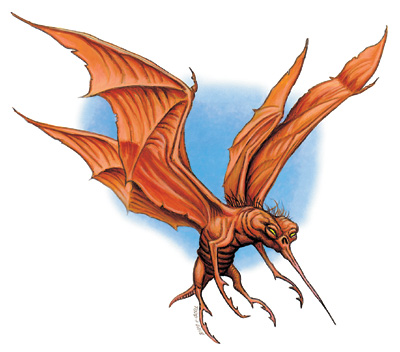 The title of this blog comes from the horrifying yet amusing idea of using Stirges as health injectors, somehow reversing their blood-sucking abilities to bestow hit points instead of damage. Every well-equipped adventurer would carry a few Healing Stirges™ for those unexpected emergencies. Simply stick the needle-like proboscis into your arm, squeeze firmly, and presto! Instant transfusion!
As an aside, if an alchemist or artificer were to make actual mechanical syringes in the D&D universe, they could look like Stirges. After all, the basic idea behind the creatures is exactly the same (though reversed in function).